COVID-19
A deeper dive into Mississippi’s COVID-19 surge


Last updated:
Similar to many states in the U.S., Mississippi is experiencing a surge in new COVID-19 cases.
The record new case counts have translated into record numbers of people hospitalized, putting a severe strain on the state’s health care system. Thursday, Mississippi’s five largest hospitals reported they had no ICU beds available to anyone, whether to COVID-19 patients or patients suffering any of a myriad of life-threatening conditions, from heart attacks to car crashes.
As a result, Gov. Tate Reeves increased restrictions on 13 counties, and State Health Officer Dr. Thomas Dobbs put out an order for hospitals to postpone elective surgeries until July 20.
Testing for COVID-19 has increased across the state, but the important metric to note is that the percentage of positive results has also increased, clearly showing an increasing number of infections in the state. In other words, the percentage of positive results going down would indicate fewer relative infections.
It’s also important to note that the bulk of new cases are being seen in younger people, especially those between 18 and 29. While healthy people in this age group are far more likely to survive the virus, they can still pass it on to older and sicker individuals.
The seven-day average of new cases for the week ending July 11 is 678, down from 734 for the previous week.
COVID -19 in long-term care facilities
Many of the new cases and deaths in Mississippi are reflected in cases and deaths in the state’s long-term care facilities. But, while only about 8.4% of the state’s cases are in LTC facilities, 48.2% of the state’s deaths from the virus are people from long-term care facilities. The number of individual COVID-19 cases in long-term care facilities total 2,959 July 11. Resident deaths total 593. The number of active outbreaks under investigation is 106.
Lauderdale County in East Central Mississippi leads the state with the highest number of cases and deaths in long-term care facilities with 202 cases and 52 deaths Saturday. It also has among the highest total COVID-19 cases and the highest number of deaths reported in the state with 963 cases and 81 deaths as of Saturday.
Nine counties — Lauderdale, Leflore, Jones, Hinds, Madison, Oktibbeha, Lincoln, Monroe and Neshoba —have 100 or more LTC cases. Eighteen counties have more than 20 LTC deaths.
Mississippi is paying special attention to any outbreaks in these facilities. Even one case is a long-term care facility is considered an outbreak because of the ages and poor health of many residents. Long-term care facilities include nursing homes, personal care homes, assisted living facilities and intermediate care facilities for individuals with intellectual disabilities. Cases in long-term acute care facilities, and psychiatric or chemical dependency residential treatment centers are now being counted separately.
COVID-19 in Mississippi counties
For months, Issaquena County was the lone spot in the state that had not been touched by the virus. That ended June 25 when Issaquena reported two cases. By Saturday, July 11, the county was reporting 10 cases and one death.
In Warren County, the rise since June 1 has been precipitous. On May 31, Warren reported 173 cases and 10 deaths. In June Warren more than doubled its case count, adding more than 252 cases and seven more deaths. After 11 days in July, the county has added another 169 cases — almost as many as the entire month of June — and four deaths, bringing the total of confirmed cumulative cases to 594 and deaths to 21.
In two weeks, neighboring Hinds County, the state’s virus epicenter, added more than 1,000 cases and 15 deaths. As of July 11, Hinds is reporting 2,908 cases and 51 deaths. Seventeen of the deaths in Hinds were residents in long-term care facilities, and 151 cases in long-term care facilities are under investigation.
In other neighboring counties, Yazoo County reports 553 cases Saturday and six deaths. Yazoo is reporting 20 cases under investigation and two deaths in long-term care facilities.
Claiborne County has also seen a precipitous rise of new cases since June 1. On July 11, the county reports 301 cases, 90 of which have been reported in the past two weeks. Claiborne reports 11 deaths Saturday, eight of which were residents in a long-term care facility. A total of 43 cases in a long-term care facility are under investigation. Claiborne County Senior Care was the site of eight resident deaths; however, the facility is no longer under investigation as of July 9
Sharkey County has reported 33 new cases in two weeks, more than doubling the number of cases from 22 cases to 48. So far, Sharkey has not reported any deaths and only one outbreak in a long-term care facilities.
Only two counties report no deaths from the virus: Benton and Sharkey. The highest county death toll in the state is 81 deaths in Lauderdale County, which also leads the state in long-term care facility cases and deaths; 52 of the deaths in Lauderdale were people in long-term care facilities.
The following 45 counties report 10 or more deaths:
| County | Total Cases | Total Deaths |
| Adams | 351 | 20 |
| Attala | 384 | 24 |
| Bolivar | 405 | 18 |
| Carroll | 181 | 11 |
| Chickasaw | 297 | 19 |
| Claiborne | 301 | 11 |
| Clarke | 223 | 25 |
| Clay | 258 | 11 |
| Copiah | 653 | 15 |
| Desoto | 1900 | 19 |
| Forrest | 993 | 43 |
| Greene | 113 | 10 |
| Hancock | 144 | 13 |
| Harrison | 1136 | 16 |
| Hinds | 2908 | 51 |
| Holmes | 586 | 41 |
| Humphreys | 163 | 10 |
| Jackson | 775 | 19 |
| Jones | 1203 | 49 |
| Kemper | 184 | 14 |
| Lauderdale | 963 | 81 |
| Leake | 635 | 20 |
| Lee | 612 | 22 |
| Leflore | 531 | 56 |
| Lincoln | 529 | 35 |
| Lowndes | 548 | 13 |
| Madison | 1446 | 38 |
| Marion | 327 | 12 |
| Monroe | 456 | 35 |
| Neshoba | 1045 | 77 |
| Newton | 375 | 10 |
| Oktibbeha | 611 | 28 |
| Pearl River | 288 | 32 |
| Pike | 499 | 20 |
| Rankin | 1087 | 15 |
| Scott | 819 | 15 |
| Smith | 246 | 12 |
| Tate | 352 | 13 |
| Tippah | 145 | 11 |
| Union | 252 | 11 |
| Warren | 594 | 21 |
| Washington | 722 | 13 |
| Wayne | 562 | 18 |
| Webster | 134 | 11 |
| Winston | 295 | 11 |
Nine counties were added to this list in the past two weeks.
COVID-19 Demographics: race, gender and age
Cases and deaths from the virus are heavily skewed toward African Americans, and MSDH is reporting racial breakdowns of each county’s statistics, available on its website. As of July 11, 57.3%. of cases (14,668) and 51.7% of COVID-19 deaths (592) in Mississippi were among African Americans.
COVID-19 cases are also skewed toward women, with 57.8% of cases among women.
Almost all the COVID-19 deaths in Mississippi occurred among people with underlying health conditions, including high blood pressure, obesity, lung disease and diabetes. The health of African Americans is contributing to their higher rate of infection and death from COVID-19.
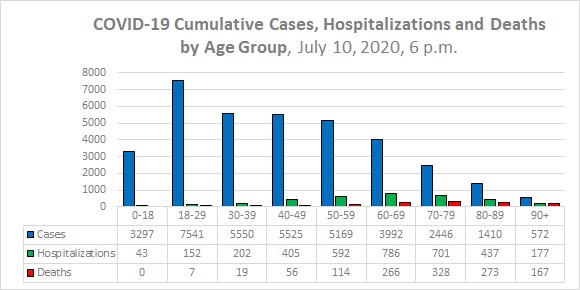
All age groups have been affected by the disease, including children under 18, with 3,297 cumulative cases as of July 11, including 246 cases in infants less than 1 year old. Forty-three young people have been hospitalized with the virus, but no deaths among juveniles have been reported in Mississippi.
New cases are being reported most frequently among those 18 to 29, with more than 7,400 cumulative cases. With more than 5,000 cases each, those from 30 to 39, 40-49 and 50-59 are also reporting far more cases than other age groups.
Deaths and hospitalizations from the virus occur most frequently among those 60 and older. As of July 11, 2,101 of Mississippi’s cumulative 3,495 hospitalizations, or 60.1%, were among people over 60, and 84% of the state’s deaths (1,034) have been people over 60.
Hospitalizations
The primary metric concerning state health officials are the numbers of people hospitalized, and that number has been steadily rising with new cases. This week, health officials warned repeatedly that some hospitals were running out of ICU beds.
The number of Mississippians hospitalized for the virus as of 6 p.m. Friday, July 10, is 909. The number includes 703 with confirmed cases of COVID-19 and 260 people with suspected but unconfirmed cases. Of those with confirmed infections, 202 were critically ill and in intensive care units and 107 were on ventilators.
Mississippi’s rate of hospitalizations for those diagnosed with COVID-19 is at 12.2% as of July 11, with another 17.9% categorized as “unknown.”
The national average for hospitalizations has seen a steady rise and stands at 107.2 per 100,000 for the week ending July 10, according to the Centers for Disease Control and Prevention; however, the rate skyrockets to 316.9 per 100,000 for those 65 and older.
Testing
The number of COVID-19 tests performed in Mississippi as of July 10 is 334,029. About 10.6% of the tests had a positive result based on the total number of confirmed cases in the state. That percentage has risen by about 2 percentage points in the last two weeks.
As more asymptomatic people are tested, the actual rate of infection will become clear. As of July 10, Mississippi has tested about 10.6% of the state’s 3.15 million people.
Another 13,123 antibody tests were performed in the state. MSDH has not provided any outcomes for these tests.
Anyone with symptoms of fever, severe cough or severe chest pains – especially those who are older or in poor health – should arrange for testing with their doctor or one of the many health care providers now performing testing, although not having a fever may not eliminate you from being tested. Health care providers can assess your health history and symptoms and perform testing for COVID-19 as needed. MSDH is also helping conduct free drive-up testing sites in many parts of the state. Always call ahead to the testing provider for instructions on safely being examined before you visit for your test.
Find a COVID-19 testing provider near you
For more information, visit the MSDH website or call the hotline at 877-978-6453, available seven days a week from 7 a.m. until 7 p.m.